Every bank that sets out to modernise KYC reaches the same fork. It can buy a suite that does onboarding end to end, keep its case manager and add better tools around it, or build its own platform. Each path has banks that chose it well and banks that regret it. The choice depends less on technology than on three things: how different your process really is, where your data lives, and who will own the result in five years.
In short
- Buy a suite when your process is close to the market standard and you value one vendor, one roadmap and one contract over fit.
- Extend when your case manager and data are sound and the problem is the manual preparation between them. Add the missing pieces and an orchestration layer.
- Build when KYC is a real source of differentiation, you have the engineering team to own it for years, and you can carry the model risk and validation burden yourself.
- Whatever you choose, demand the same three properties: outputs that cite their sources, decisions that stay with people, and a decision record you own.
The three paths
| Buy a suite | Extend what you have | Build your own | |
|---|---|---|---|
| What it is | One platform for intake, CDD, screening, risk, review and case management | Keep the case manager and core data; add preparation, screening, registry and agent layers around them | Your own services and data model, using open-source and cloud components |
| Time to first value | Depends on configuration and migration; often a programme, not a project | Short for the first case type, since existing systems stay | Long: the platform comes before the first case |
| Fit to your process | You adapt to the product, within its configuration | Your process, with new steps prepared automatically | Exactly your process |
| Data | Moves into the suite | Stays where it is; read by the new layer | Wherever you design it |
| Model risk | Shared with the vendor; you still validate | Shared; each component validated | Entirely yours |
| Who owns it in five years | The vendor’s roadmap | You own the process; vendors own components | Your engineering team |
When buying a suite is right
A suite is a sensible choice when the bank’s KYC process is close to what most banks do, the existing systems are old enough that replacing them is overdue anyway, and the organisation prefers one accountable vendor. The costs are migration, adapting procedures to the product, and dependence on one roadmap for every change, including the AI capabilities that are moving fastest.
Questions to ask a suite vendor:
- Can every value on a case be traced to a document line, registry entry or list entry?
- Which actions can its AI take without a person, and can we cap that ourselves?
- Is our risk methodology expressed as settings we can read and change, or as code only the vendor can change?
- Can we export complete decision records, with the evidence, in a format we can read without the product?
When extending is right
Many banks already have a case manager they are reasonably happy with, a screening engine that works, and customer data in a core system. What they lack is the preparation between those systems: the reading, comparing, registry walking and memo writing that analysts do by hand. Extending means adding that layer without replacing what works.
Extending: the new layer reads your systems and prepares each case; the decision and its record stay with your people.
The risk of extending is integration sprawl: five new tools, each integrated with five old systems. The way to avoid it is to make one layer responsible for preparing the whole case, and to let it read existing systems rather than copy them.
When building is right
Building makes sense when KYC is part of how the bank competes (for example, onboarding speed in a business line where it wins customers), when the process genuinely differs from the market, and when there is an engineering team that will own the platform for years. It is the path with the most control and the most responsibility.
What building really includes
The case manager and the user interface are the visible part. The larger part is the engines behind them: document reading with citations, MRZ validation, registry walking and ownership calculation, name matching that can be explained, a risk model with versioning, a decision record, and the validation evidence for each. Then the agent layer: prompts, grounding checks, autonomy controls and monitoring. Each of these needs tests, documentation and someone on call.
The questions that decide
If an honest comparison shows your onboarding steps match the market’s, the case for building weakens sharply.
A sound case manager and customer data argue for extending; systems due for replacement argue for a suite.
Some banks require customer data to stay in their own cloud or data centre. That narrows the options quickly.
Every path needs validation; building means doing all of it yourself, including for AI components.
A platform nobody is funded to maintain becomes the next remediation programme.
Properties to insist on, whichever path
Ratings, scores and recommendations without sources. Fast to demonstrate, slow to examine, and hard to switch away from because the reasoning lives inside the product.
Every value cited, every calculation reproducible, every decision recorded with what the controls said. You can examine it, validate it and, if you have to, move it.
- Evidence: every fact on a case traceable to its source.
- People decide: AI prepares; a cap on its autonomy that the bank sets and the vendor cannot raise.
- Policy as settings: risk factors, thresholds, prohibited jurisdictions and case controls readable and changeable by the bank, with versions.
- A decision record you own: exportable, complete, readable without the product.
- Read, don’t copy: source systems stay the source; the platform reads them rather than becoming a second copy of the customer master.
Where InsightKYC fits
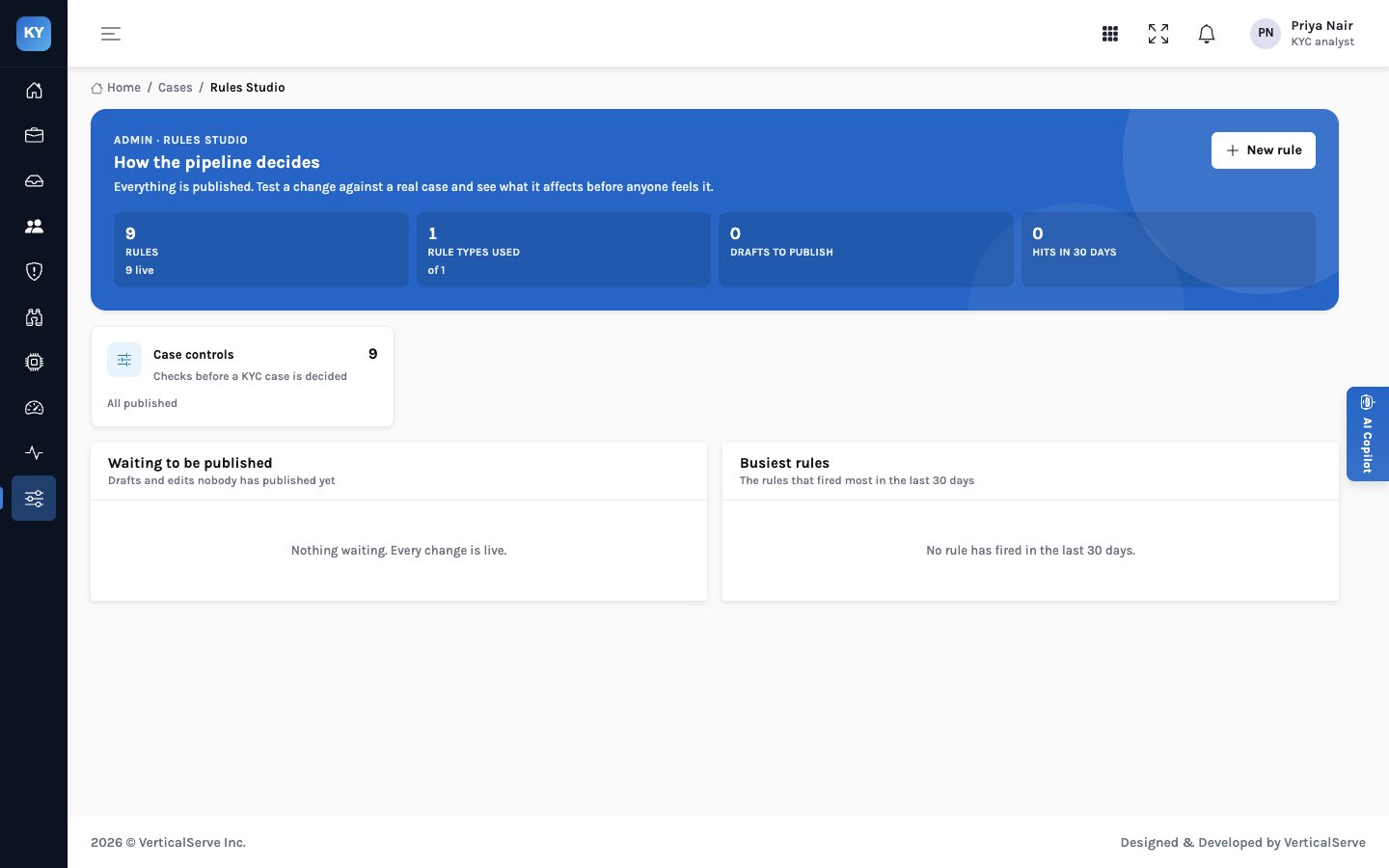
InsightKYC is built for the extending path. It reads the bank’s own systems (applications, customers, the company registry, documents, screening lists, accounts and transactions) read-only, prepares each case with ten agents, and keeps decisions and the decision record with people. Case controls live in a rules studio the bank edits; the risk model’s factors and thresholds are settings (illustrative in our demo, which runs on a fictional bank). It can also run as the whole case workflow for a bank without a case manager.
What it means for each audience
For the CCO & MLRO
Whatever the path, write the evidence, autonomy and record requirements into the selection criteria. They are what an examiner will test.
Count validation effort in the comparison; it differs most between paths.
For the KYC operations lead
Map today’s process honestly before choosing. Teams often overestimate how different their process is.
Prefer the path where analysts review prepared work in the tools they already use.
For the board
This is a five-year decision dressed as a procurement. Ask who will own the platform, and what leaving it would cost.
The cheapest option to start is rarely the cheapest to keep.
Buy, extend or build: the right path is the one whose result you can examine, change and own.
Choose on process fit, data and ownership, and refuse any option whose outputs cannot show their evidence.