Ask any KYC operations lead where the hours go and screening will be near the top. Not the true matches, which are rare, but the long tail of possible matches: a customer who shares a name with someone on a sanctions list, a PEP list or a news article. Each one has to be looked at, compared and cleared with a reason. The question isn’t how to stop screening. It’s how to make every alert faster to clear without making a real match easier to miss.
In short
- A blended score hides the evidence. Show the name similarity, the date-of-birth comparison and the nationality comparison separately, on every match.
- Fuzzy where names vary, strict where they don’t. Word order and transliteration vary; a surname that is simply different is a different person.
- Keep near-exact names even when identifiers disagree. A list entry with a wrong date of birth must still surface, as a weak match.
- Let an agent propose, never let it clear a strong sanctions match. Every disposition is recorded with who, when and a reason a reviewer can check.
Where screening time goes
Screening runs at onboarding, at periodic review and whenever the lists change. Every party is screened, not just the applicant: directors, beneficial owners, sometimes signatories. Each list carries aliases. A modest book produces a steady stream of possible matches, and each needs the same steps:
- Open the list entry and read what identifiers it has.
- Find the customer’s identifiers, usually in a passport or the application.
- Compare them, decide, and write down why.
Steps one and two are lookups. Step three is judgement. Most tools leave all three to the analyst.
Why the threshold isn’t the answer
Raising the match threshold reduces alerts by missing more of the close-but-not-exact names that transliteration and aliases produce. For sanctions, US enforcement by OFAC is on a strict liability basis, so a missed match is the costly error. Better evidence per alert is the safer lever.
Three scores, not one
InsightKYC scores each match in three parts and keeps all three on the match:
| Part | Method | Shown to the analyst as |
|---|---|---|
| Name | Normalised names (case, accents and punctuation removed); token-sort similarity so “Orlov Tatiana” equals “Tatiana Orlov”; Jaro-Winkler only when token-sort is already 0.85 or more; the surname must agree | A number from 0 to 1, and which alias it matched |
| Date of birth | Same date, same year, different year, or not on the list | “same date of birth”, or “different year of birth (1964 on the list, 1989 for the customer)” |
| Nationality | Same, different, or not on the list | “same nationality”, or “different nationality (RU on the list)” |
The three combine into a strength. Strong: the name matches and the identifiers agree. Possible: the name matches and the identifiers are missing. Weak: the name matches but the identifiers point to someone else. A weak match isn’t hidden; it is put in front of the analyst with the difference already spelled out.
Every match gets a strength and a proposal. A person records every disposition.
Two calibration rules that matter
Building the demo exposed both failure modes of fuzzy matching, and the rules that fixed them are worth stating because every screening engine needs a version of them.
A shared first name is not a match
Early versions matched “Miguel Morales” to “Miguel Torres” and “Tatyana Orlov” to “Tatiana Kozlov”: the first name agreed and the surnames looked alike to a string metric. The fix was to require the query’s surname to agree with one of the candidate’s name tokens, allowing a spelling variant, and to apply the more generous Jaro-Winkler comparison only when the token-sort score was already high. For one demo applicant this removed eight look-alike entries and left the single real match.
A wrong date of birth must not hide a name
The opposite error: penalising a different date of birth so heavily that near-exact names dropped below the threshold. List entries are sometimes wrong or incomplete. A name that matches at 0.92 or more is now kept as a weak match whatever the identifiers say, so a person always sees it.
Every change trades misses for noise, and nobody can see which matches moved.
Surname agreement removes look-alikes; a floor for near-exact names keeps entries with bad identifiers. Each rule has a test with a planted case.
Adverse media is different
News articles don’t carry dates of birth. A name match against an article is weaker evidence than a match against a list entry, and common names collide constantly. InsightKYC asks more of a media match: the surname must agree and the name score must be 0.94 or more. What remains is shown with the headline, outlet and date so the analyst can judge whether the article is about this customer.
The agent proposes; a person disposes
| Proposal | When | Can the analyst accept it in one click? |
|---|---|---|
| False positive | Weak: surname agrees but the year of birth or nationality differs | Yes, from the agent’s prepared decision, with the agent’s reason as the starting point |
| Needs information | Possible: identifiers missing on one side | Yes, and usually a request to the customer follows |
| True match | PEP or media where everything agrees | Yes, the analyst records it |
| Escalate | Strong sanctions match | No agent clears it: a person records the disposition with a reason |
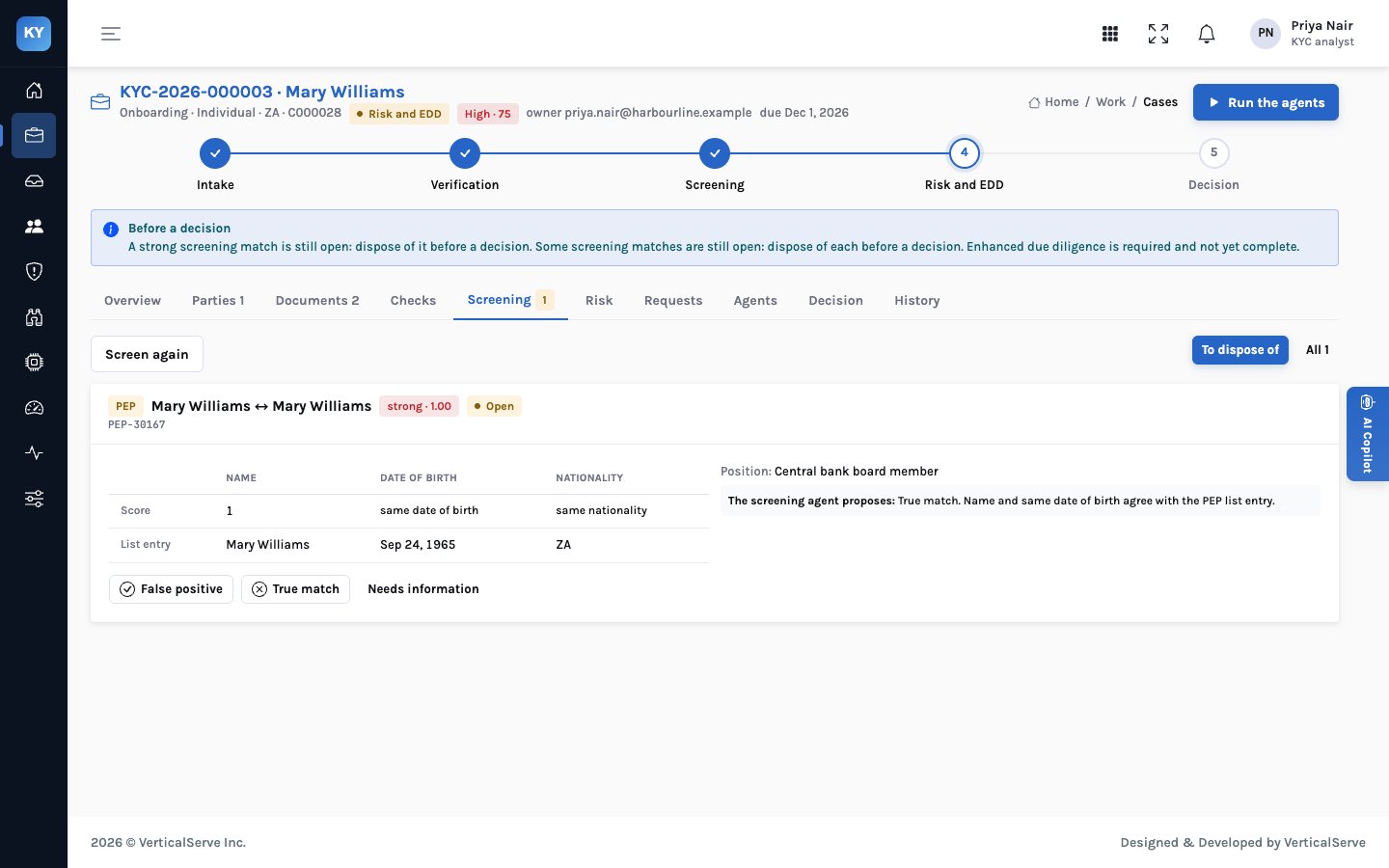
Every party, every alias, every list. Matches stored with their three-part scores and a proposed disposition.
The agent prepares one decision per case: “Dispose of 5 screening matches”. The analyst reads the reasons and accepts, rejects or asks.
Possible matches and anything strong are opened one by one with the customer’s documents.
No agent proposal clears them; they block the case until a person disposes of them.
Sample dispositions by reason and by reviewer. A reason that just says “not a match” is a finding.
Measuring screening honestly
What it means for each audience
For the CCO & MLRO
Every disposition carries a reason a reviewer can verify, and strong sanctions matches are structurally kept away from automation.
Calibration is a set of named rules with tests, which is far easier to defend than a threshold moved by feel.
For the KYC operations lead
The queue is smaller because look-alikes never arrive, and each remaining alert shows the comparison already done. Analysts spend their time on possible and strong matches.
Agreement with the agent’s proposals is tracked, so you know when to trust them more.
For the board
The bank screens every party, can show why each match was cleared, and measures what matters: open strong matches.
Fewer analyst hours on noise, without accepting more risk of a miss.
What to be careful about
- Naming conventions vary. “Surname last” doesn’t hold for every culture. Test the surname rule on your own customer population and lists, and use aliases and document names, not just the application.
- Calibrate on your lists. The demo’s lists are invented. Real lists have their own quirks in how aliases and dates are recorded.
- Re-screen when lists change. A customer cleared last month can match a designation made today.
The fastest way to clear a false positive is to show the analyst the difference.
Score the name, date of birth and nationality separately, fix failure modes with named rules, and keep every strong sanctions match in human hands.