A politically exposed person is not a prohibited customer. Every major anti-money-laundering framework says the same thing: a PEP can bank with you, but the bank has to know where the money came from, a senior person has to agree to the relationship, and the account has to be watched more closely afterwards. The difficulty is rarely the rule. It is doing all three steps, in order, with evidence, while the customer waits.
In short
- PEP status raises the bar, it does not close the door. FATF Recommendation 12 asks for senior management approval, reasonable measures to establish source of wealth and source of funds, and enhanced ongoing monitoring.
- The work is a sequence, and order matters. Confirm the match, rate the risk, gather the enhanced due diligence evidence, then decide. Skipping ahead is how files end up approved before the evidence exists.
- Agents can prepare every step. The screening agent proposes the disposition, the risk agent rates the customer, the EDD agent drafts the request to the customer, and the case writer drafts the memo.
- Two people decide. The analyst who prepared the case submits it; a lead who did not submit it approves or declines. The decision record keeps both names.
The situation
The case below runs on InsightKYC’s demo data for Harbourline Bank, a fictional bank. Everything in it is invented, but its shape is one every onboarding team will recognise. Mary Williams, who lives in South Africa, applies for a personal account through her relationship manager. On the application she ticks the box that says she holds, or has held, a prominent public function. She expects to receive payments from, and make payments to, Russia as well as South Africa.
The case opens as KYC-2026-000003, an onboarding case for an individual. Her passport and
a utility bill are on file. Within minutes of the agents running, four things are known:
| Fact | Where it came from | What it means |
|---|---|---|
| She declared PEP status | The application form | The bank must treat her as a PEP unless screening shows otherwise |
| Strong match to PEP list entry PEP-30167 | Screening against the PEP list (fictional for the demo) | Name and date of birth agree with the list entry: the declaration is confirmed |
| Risk rated high, 75 points | The risk model, factor by factor | High risk requires enhanced due diligence and a one-year review cycle |
| Identity and address checks pass | The document reader and verification agent | Nothing about who she is is in doubt; the open question is her money |
Why this is hard to do by hand
Nothing in the case is unusual. What makes PEP onboarding slow is that each step depends on the one before it, and in most banks each step lives in a different place.
- The screening tool raises the PEP match, and an analyst clears or confirms it there. The confirmation often never reaches the risk rating automatically.
- The risk rating is a spreadsheet or a scorecard in the case manager. Whether “PEP” adds points depends on someone ticking the right box.
- The EDD request is an email the analyst writes from a template, sent from a personal mailbox. The customer replies with attachments that have to be saved back to the file.
- Senior approval is an email thread. Six months later, nobody can say what the approver saw when they agreed.
The match is cleared in the screening tool, the rating is typed into a scorecard, the request goes from the analyst's mailbox and the approval is a reply-all. The file is assembled afterwards.
The match, the rating, the request and the decision sit on the same case. Each step reads the one before it, and the decision record freezes all of them at the moment the lead approves.
How InsightKYC handles it
Each box is a step on the same case. The case cannot reach the decision box while EDD is open.
1. The match is proposed, not assumed
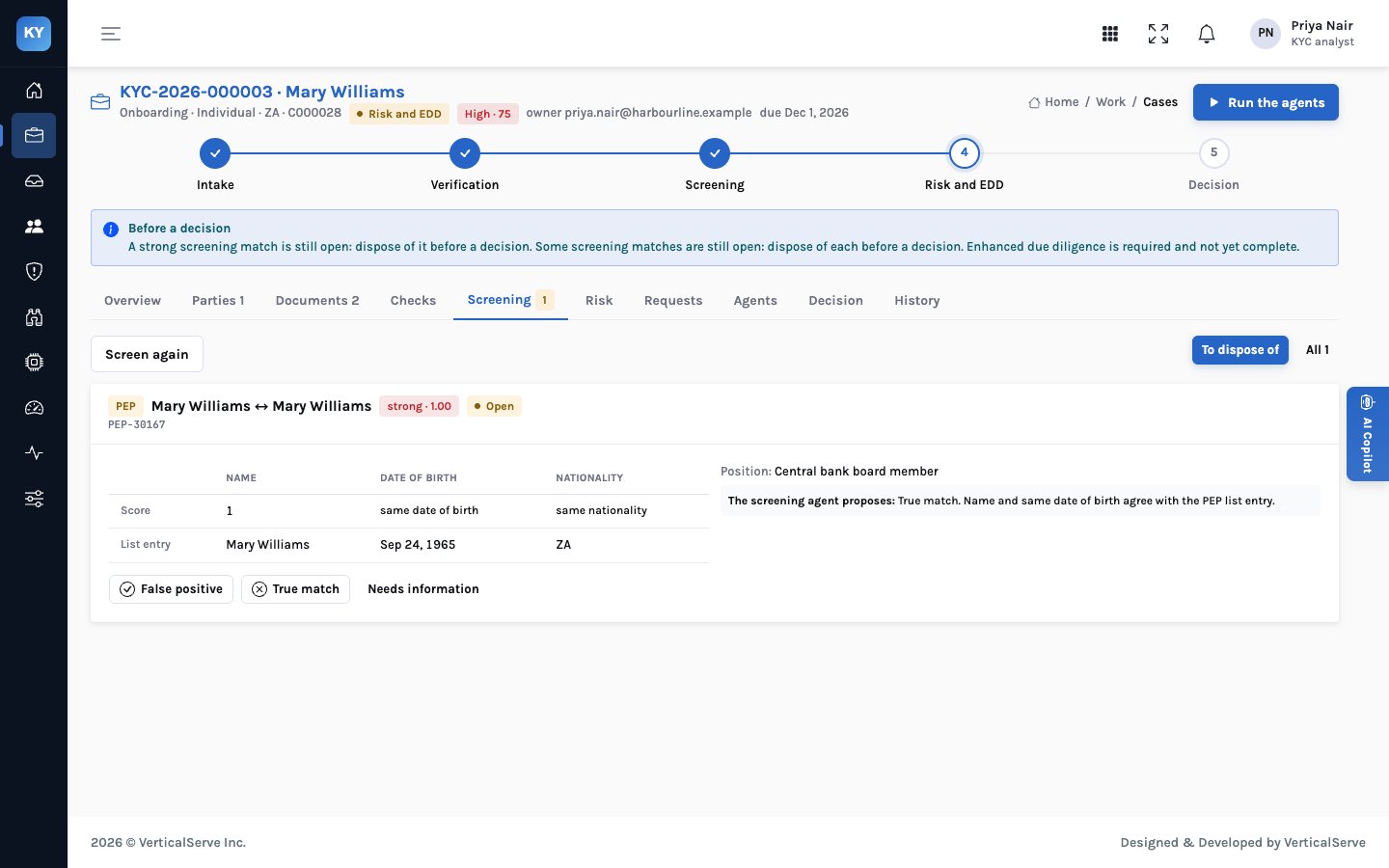
The screening agent compares every party on the case with the sanctions, PEP and adverse-media lists. For Mary Williams it finds one strong match on the PEP list: the name and the date of birth agree with entry PEP-30167. It proposes true match and says why. It does not record the disposition itself. An analyst reads the comparison and accepts, rejects or asks.
2. The rating shows its arithmetic
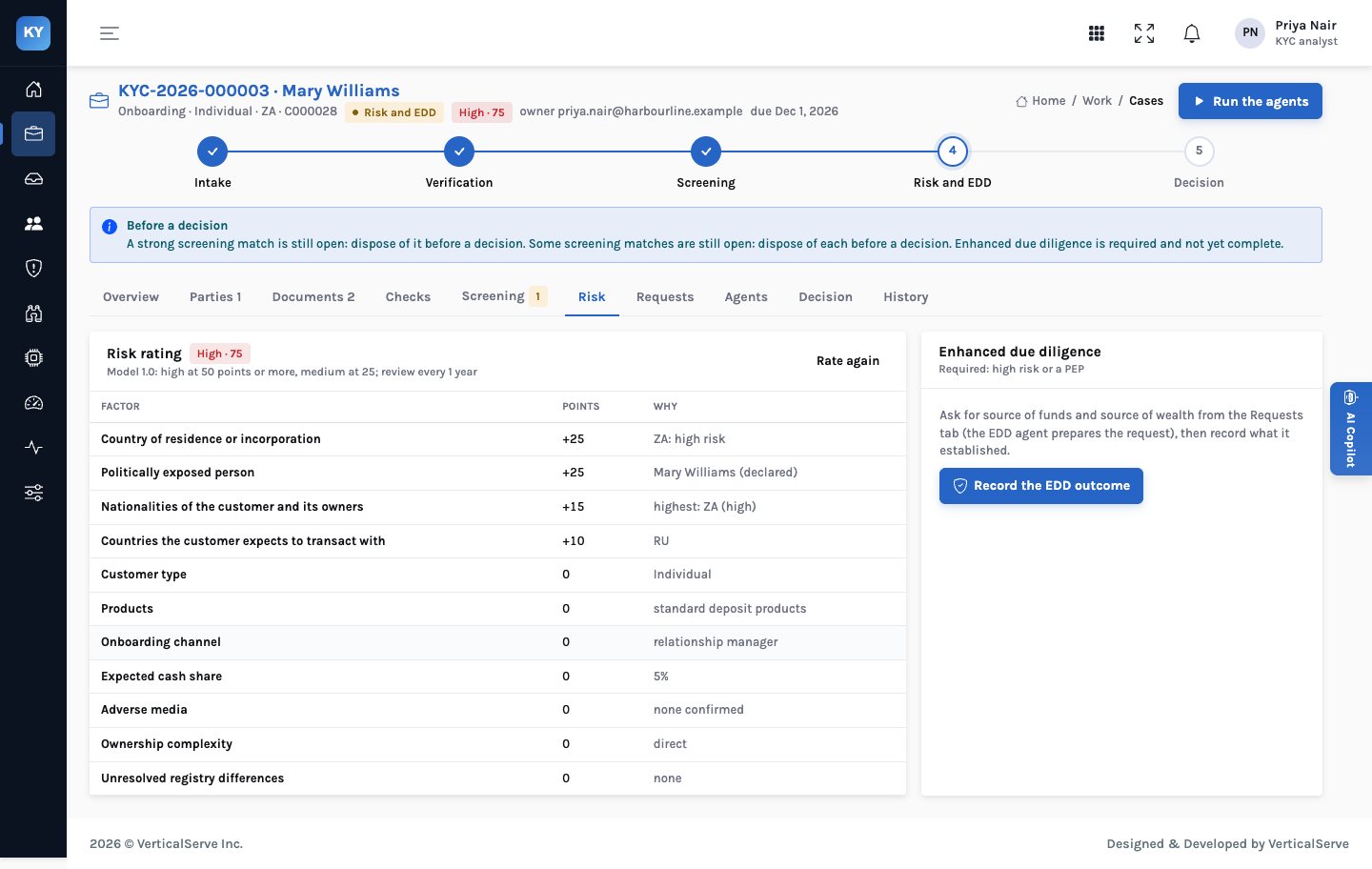
The risk agent rates the case with a points model. Every factor that adds points says why. For this customer, four factors carry the score:
| Factor | Points | Why |
|---|---|---|
| Country of residence | +25 | South Africa is rated high risk in the bank's country list |
| Politically exposed person | +25 | Declared on the application and confirmed by screening |
| Nationalities of the customer and its owners | +15 | The highest-rated nationality on the case |
| Countries the customer expects to transact with | +10 | Russia is on the declared list |
| Total | 75 | High at 50 or more; enhanced due diligence required; review every year |
The country ratings, thresholds and review cycle in the demo are an illustrative policy, set for a fictional bank. A bank loads its own. The point is that the rating is a sum of named reasons, so a relationship manager who disagrees can disagree with a specific line.
3. The EDD request is drafted and held
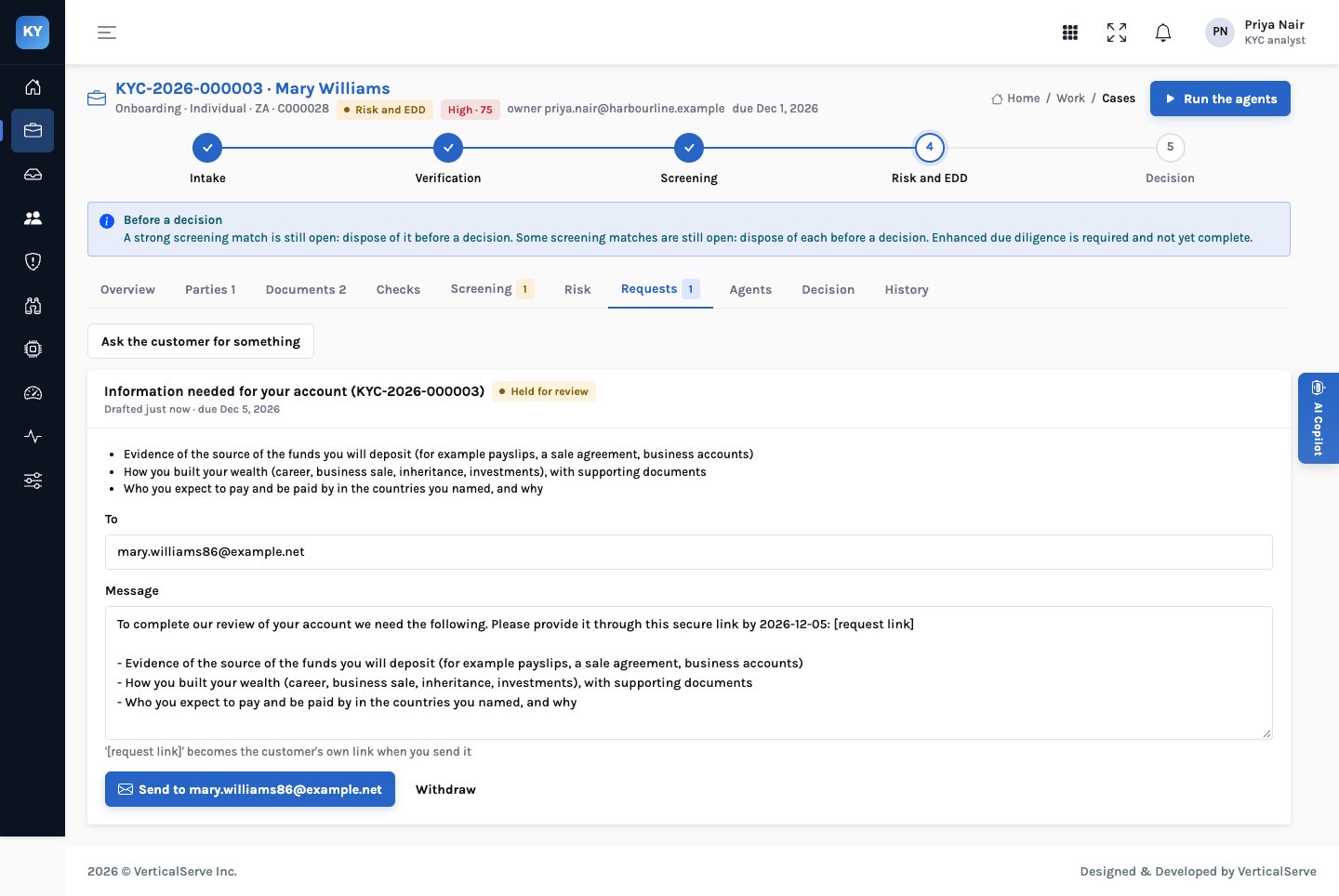
Because EDD is required, the EDD agent prepares a request to the customer. It asks for three things: evidence of the source of the funds she will deposit, how she built her wealth, and who she expects to pay and be paid by in the countries she named. The agent cannot send it. When the analyst accepts the prepared decision, the request lands on the Requests tab held for review, where the analyst can edit the wording and the address before sending.
4. Two people decide
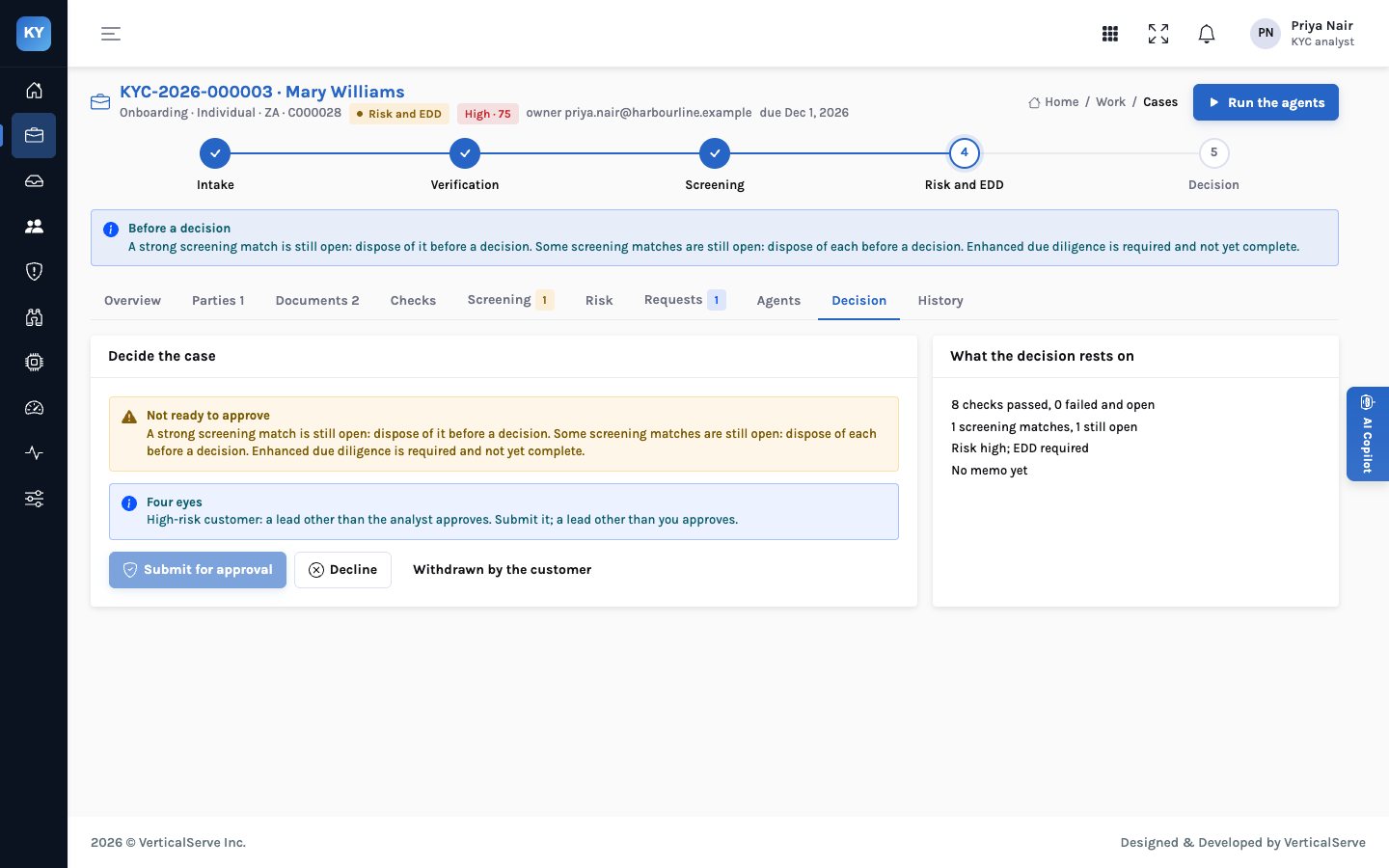
A high-risk or PEP case cannot be approved by the person who prepared it. The analyst submits the case for approval once nothing blocks it. A lead who is not the submitter then approves or declines. The case controls, kept in Rules Studio, block the decision while the PEP match is undisposed or EDD is incomplete, and refer it for senior approval because the customer is a PEP and high risk.
Who does what
The analyst and the lead are different people, and the system enforces it.
Documents are read, identity and address checks run, every party is screened and the case is rated. The agents prepare; nothing is decided.
Read the side-by-side comparison. If name, date of birth and nationality agree, accept the true-match proposal and record why.
Read each factor. If a factor is wrong because the facts are wrong, fix the facts; a lead can override the rating with a reason.
Review the drafted request, adjust the wording, confirm the address, and send. The link is shown once.
When the customer answers, read the uploads and write the EDD outcome: source of funds, source of wealth, and the expected payment flows.
Accept or edit the case writer’s memo and submit. The analyst cannot approve their own high-risk case.
A lead who did not submit reads the memo and the controls and decides. The decision record keeps the controls, the rating and every disposition as they stood.
The analyst’s choices
| If | Then | What goes on the record |
|---|---|---|
| The list entry is a different person | Record a false positive; the declaration still makes her a PEP | The reason, e.g. a different date of birth, and the analyst’s name |
| The customer cannot evidence her source of wealth | Ask again, or recommend declining | The request, the answer and the analyst’s EDD note |
| The rating looks too high or too low | Ask a lead to override with a reason | The model’s rating, the override and who made it |
| The lead disagrees with the memo | The lead declines or sends it back | The decision and its reason, with the submitter and the decider named |
What it means for each audience
For the CCO & MLRO
The FATF standard asks for senior approval and reasonable measures on source of wealth and funds. The decision record shows both, with names and dates, without anyone assembling a file afterwards.
PEP policy becomes a set of controls you can read, not a paragraph in a procedures manual.
For the KYC operations lead
The analyst works one case in order instead of four systems. The agents draft the request and the memo; the analyst edits and decides what to send.
Leads see a queue of cases submitted for their approval, each with what blocks it already cleared.
For the board
A PEP relationship is a reputational decision. The board can ask who approved each one and on what evidence, and get an answer from the record.
Declining a PEP is also a decision, and it is recorded the same way.
Metrics to track
What to be careful about
- Declared and confirmed are different facts. A customer who declares PEP status is a PEP for the bank’s purposes even when no list entry matches. Don’t let a false positive on the list clear the declaration.
- Source of funds is not source of wealth. One is where this money came from; the other is how the person came to have what they have. Ask for both, and record what each answer established.
- Lists differ. The demo uses fictional lists. Commercial PEP databases vary in scope, including family members and close associates. Know which list the bank licenses and what it covers.
- The rating policy is the bank’s. The demo’s country ratings and thresholds are illustrative. Load and approve your own.
A PEP is a customer you can say yes to, provided you can show how you got there.
Confirm the status, rate the risk, establish the money, and have someone other than the preparer decide. The record of each step is the answer to every later question.