Every customer risk rating will be challenged. A relationship manager wants to know why their client is high risk. An auditor samples a file and asks why a customer with payments to a high-risk country was rated medium. A supervisor asks how the model works and whether it is applied the same way to everyone. If the honest answer to any of them is “the system said so”, the rating isn’t doing its job.
In short
- A rating is a decision about how much diligence a customer gets. High risk means enhanced due diligence, senior approval and more frequent review, so the rating has to be defensible.
- Use points with reasons. Each factor adds a number of points and says why, in words a relationship manager understands. The total maps to low, medium or high at published thresholds.
- Keep “prohibited” separate from the score. A prohibited country or industry isn’t a lot of points. It is a policy line, and it should say which line.
- Allow overrides, never silently. A lead can change a rating with a written reason; the model’s rating stays beside it on the record.
What the rating is for
The risk-based approach is the foundation of the FATF standards (Recommendation 1): a bank should understand its money-laundering and terrorist-financing risks and apply more diligence where the risk is higher and less where it is lower. The customer risk rating is where that principle meets a single customer. It decides three practical things:
| The rating decides | Low | Medium | High |
|---|---|---|---|
| Level of due diligence | Standard | Standard | Enhanced: source of funds and wealth, more evidence |
| Who can approve | Analyst | Analyst | A lead who did not submit the case (four eyes) |
| How often it is reviewed | Every 3 years | Every 2 years | Every year |
The review cycles in that table are InsightKYC’s demo settings, not a regulatory requirement: each bank sets its own and writes them into policy. What matters is that the rating drives them automatically, so a customer re-rated high moves to an annual cycle without anyone remembering to change it.
Why black-box ratings fail
Ratings go wrong in two familiar ways. Spreadsheet models drift: someone adds a column, someone else changes a weight, and three years later nobody can say which version rated which customer. Statistical or machine-learned scores can be accurate on average and still unexplainable for the one customer an auditor picks.
No factors, no version, no threshold. The relationship manager can’t argue with it, and the auditor can’t test it.
Every point has a reason. Disagree with one line and you know exactly what would change the outcome.
A points model, factor by factor
InsightKYC’s demo model has eleven factors. Each one reads facts the case has already
established, from the application, the documents, the registry and the screening, and adds points
with a sentence of explanation. These are the factors and the points they added for one demo customer,
Mary Williams, a politically exposed person resident in South Africa (KYC-2026-000003):
| Factor | Points | Why, as the case shows it |
|---|---|---|
| Country of residence or incorporation | +25 | ZA: high risk in the illustrative country list |
| Politically exposed person | +25 | Mary Williams (declared, and confirmed by screening) |
| Nationalities of the customer and its owners | +15 | Highest: ZA (high) |
| Countries the customer expects to transact with | +10 | RU |
| Customer type | 0 | Individual |
| Products | 0 | Standard deposit products |
| Onboarding channel | 0 | Relationship manager |
| Expected cash share | 0 | 5% |
| Adverse media | 0 | None confirmed |
| Ownership complexity | 0 | Direct |
| Unresolved registry differences | 0 | None |
| Total | 75 | High: at or above 50 |
The thresholds are illustrative: high at 50 points or more, medium at 25. So are the country and industry lists. A bank deploying this replaces them with its own risk assessment, and the model version is stored on every assessment so the rating can be reproduced later.
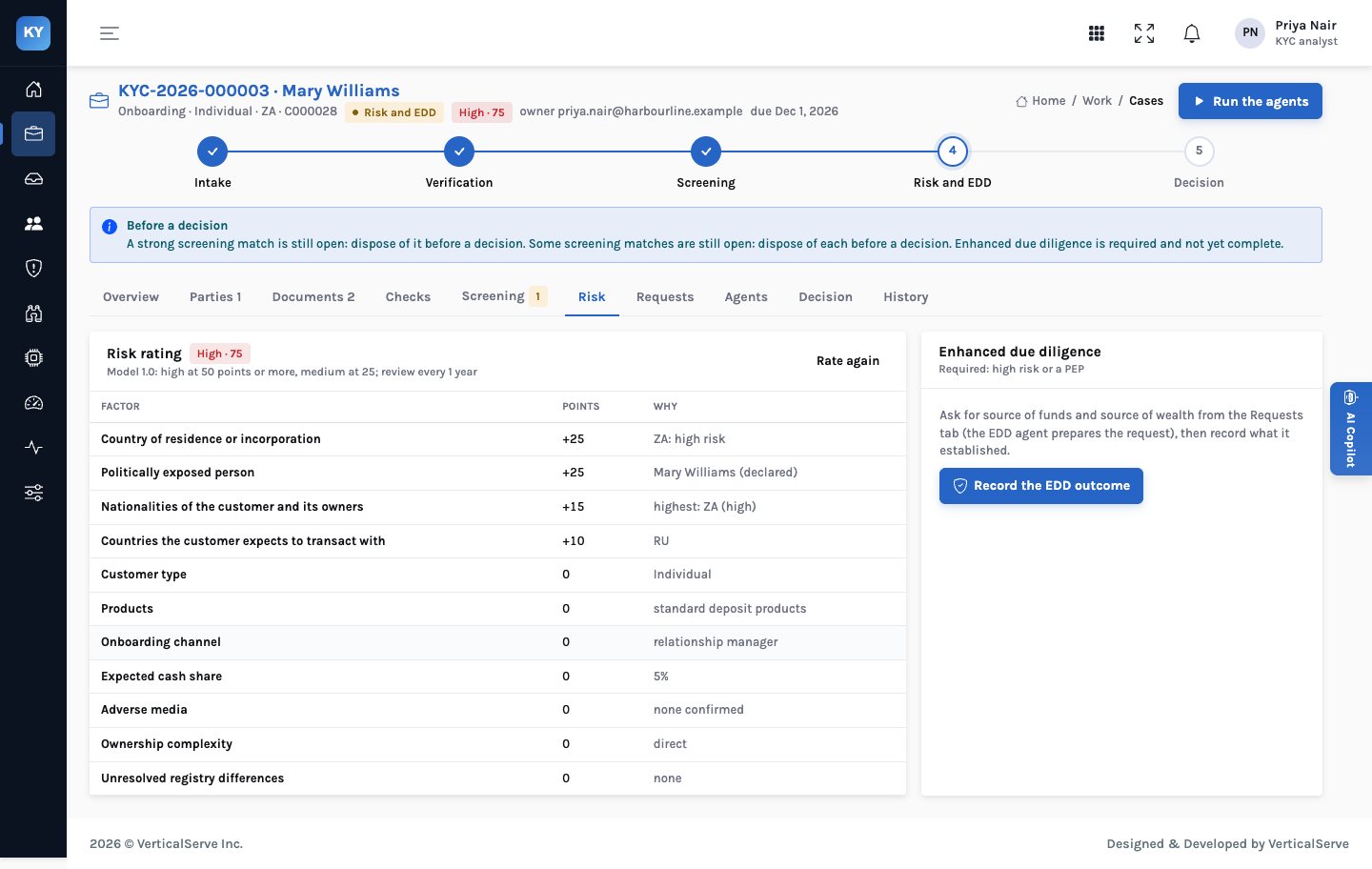
Points decide low, medium and high. Prohibition is a separate test that overrides the points.
Prohibited is not a score
Some customers the bank won’t take whatever the points say: a country it doesn’t do business with, an industry outside its appetite, a confirmed sanctions match. Folding that into the score, say as 100 points, invites the question of what else could reach 100. Keep it as a separate test that names the rule.
In the demo, another applicant, Ali Al-Farsi (KYC-2026-000010), scores only 15 points, but
holds an Iranian nationality, and the illustrative policy lists Iran as prohibited (it is one of the
jurisdictions on the FATF’s call-for-action list). The rating is “prohibited”, the
reason is shown, and the PROHIBITED case control blocks approval.
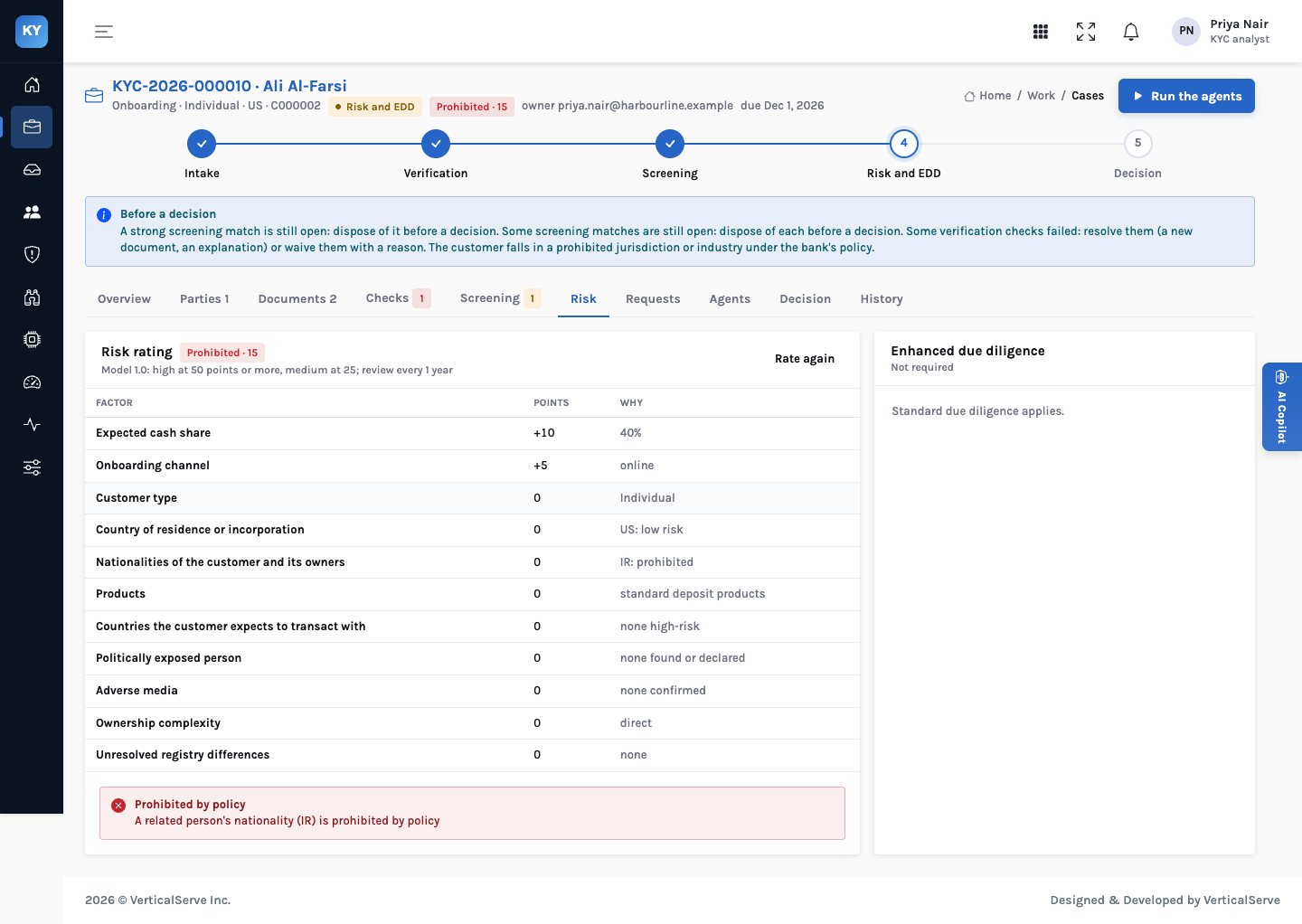
Overrides with a trail
No model sees everything. A lead may know the customer’s business has changed, or that a high-risk country appears only because of one historical payment. InsightKYC lets a lead override the rating to low, medium, high or prohibited, and requires a reason. The assessment keeps both: the model’s rating, and the override with who made it and why.
The rating reads only what the case has established, so it runs after documents are read, the registry walked and parties screened.
Applies the model, records the version, factors, points and reasons, and whether enhanced due diligence is required.
Checks each factor against the case. A wrong fact is fixed at its source (a document, a party), and the case is rated again.
Changes the rating with a written reason. The model’s rating stays on the record beside the override.
High risk or a PEP triggers EDD and four eyes; the next review date follows the rating when the case is approved.
Governing the model
A rating model is a model, and banks in the US apply model risk management guidance (the Federal Reserve’s SR 11-7) to tools like it. A transparent points model makes the main questions easy:
- What does it do? The factor list and the thresholds are the documentation.
- Which version rated this customer? The model version is stored on every assessment.
- Is it applied consistently? The same facts give the same points; agents don’t vary it.
- How often is it overridden, and why? Overrides are counted and their reasons are readable, which is the best signal that a factor needs recalibrating.
What it means for each audience
For the CCO & MLRO
The rating methodology can be handed to an examiner as it is. Every rated customer carries the version, the factors and the reasons, and every override names its author.
Prohibition is visible as policy, not hidden inside a number.
For the KYC operations lead
Analysts spend their time checking reasons, not doing arithmetic. When a rating is wrong, the factor list shows which fact is wrong.
Review dates follow the rating automatically.
For the board
The bank can say what makes a customer high risk in a sentence, and show how many high-risk customers it has and when each was last reviewed.
Changing risk appetite is a change to a published list, with an effect that can be seen before it goes live.
What to be careful about
- The points are policy. The demo’s weights and lists are illustrative. Yours should come from your enterprise-wide risk assessment, and be approved like any other policy.
- Garbage in. A rating built on an unverified declaration is only as good as the declaration. That is why the rating runs after the checks and the registry walk, not before.
- Points can hide interactions. Two medium factors together may matter more than their sum. Watch overrides for patterns like that, and add a factor when you find one.
If you can’t say why a customer is high risk in one sentence, you can’t defend the rating.
Give every point a reason, keep prohibition separate, and let people override only in writing.