Supervisors rarely fault a bank for not knowing a rule. They fault it for not applying its own rules the same way twice: a high-risk customer rated medium because one analyst read the policy differently, an enhanced due diligence file with no source of wealth, a periodic review three years late. A KYC programme is judged less on what its policy says than on whether the files prove the policy was followed.
In short
- The risk-based approach is the organising idea. FATF Recommendation 1 asks institutions to understand their risks and apply measures in proportion. Supervisors expect that reasoning to be written down and applied consistently.
- Customer due diligence has four parts. Identify and verify the customer, identify the beneficial owner, understand the purpose of the relationship, and keep it under ongoing review (FATF Recommendation 10).
- Higher risk means more, and it must be visible. Politically exposed persons, high-risk countries and complex structures need enhanced measures, senior approval where required, and evidence of both.
- The file is the evidence. Examiners sample files. If the reasoning is not in the file, as far as the examination is concerned it did not happen.
The international baseline
National KYC rules derive from the FATF Recommendations. The ones a KYC programme is built around are few, and worth knowing by number.
| FATF Recommendation | What it asks of a bank | What it looks like in a file |
|---|---|---|
| 1 — Risk-based approach | Identify and assess money laundering and terrorist financing risk; apply measures in proportion to it | A customer risk rating with reasons; EDD where the rating calls for it; simplified measures only where the risk is shown to be low |
| 10 — Customer due diligence | Identify and verify the customer and beneficial owner; understand the purpose and intended nature of the relationship; ongoing due diligence | Verified identity, ownership structure, declared purpose and expected activity, and a review date |
| 11 — Record keeping | Keep CDD records and transaction records for at least five years | The documents, the checks and the decision, retrievable |
| 12 — Politically exposed persons | For foreign PEPs: senior management approval, source of wealth and source of funds, enhanced ongoing monitoring; risk-based measures for domestic PEPs | The PEP determination, the approval by a senior person, and the evidence of source of wealth and funds |
| 19 — Higher-risk countries | Enhanced due diligence for relationships with countries FATF calls for it on | The country factor in the rating and the measures it triggered |
| 24 and 25 — Transparency of legal persons and arrangements | Countries make beneficial ownership information available; banks use it | Registry evidence and how differences with the declaration were resolved |
How national rules turn this into obligations
United States
US banks implement these standards through the Bank Secrecy Act and FinCEN’s rules. The
Customer Identification Program rule sets out what must be collected and verified for each
customer. The Customer Due Diligence Rule (31 CFR 1010.230) adds beneficial
ownership for legal entity customers, and the program rules require banks to understand the
nature and purpose of each relationship to build a customer risk profile, and to conduct
ongoing monitoring to keep customer information current. Examiners work from the FFIEC BSA/AML
Examination Manual, which has sections on customer identification, customer due diligence,
beneficial ownership and higher-risk customers.
European Union
The Anti-Money Laundering Regulation, Regulation (EU) 2024/1624, applies directly from July 2027 and sets out customer due diligence, simplified and enhanced measures and beneficial ownership in one text, rather than through national transpositions of a directive. The new authority, AMLA, is responsible for harmonised technical standards and, for some of the largest firms, direct supervision.
United Kingdom
The Money Laundering Regulations 2017 set out customer due diligence, enhanced due diligence and the treatment of PEPs, and industry guidance from the Joint Money Laundering Steering Group is widely used to interpret them.
Read your own regulator
This post describes the common shape. Exemptions, timings and definitions differ by jurisdiction, and they change. Treat it as a map of the questions to ask, not a substitute for the rules that apply to your firm.
What an examiner looks for
An examination of KYC tends to move from the policy to the files and back. The questions are predictable.
From the policy to the files and back: the shape of most KYC examinations.
- Is the methodology written down? Which factors raise a customer’s risk, by how much, and where the thresholds are. A rating that cannot be reproduced from the methodology will be questioned.
- Do the files match the methodology? Examiners sample files and re-derive the rating. A file rated low with a factor that should make it high is a finding.
- Is enhanced due diligence actually enhanced? For each high-risk or PEP customer, is there evidence of source of funds and source of wealth, and was the relationship approved by someone with the authority to approve it?
- Are screening alerts cleared with reasons? A disposition of “false positive” with no reason is weak evidence. One that says the date of birth and nationality differ is strong.
- Are reviews on time? Ongoing due diligence means customers are reviewed on a cycle set by risk and when something changes. A backlog of overdue reviews is one of the most common findings.
- Can the bank show its numbers? Management information on volumes, ageing, overdue reviews, overrides and quality-assurance results, and evidence that someone acts on it.
Evidence that makes the answer easy
“Medium risk. ID verified. Screening clear.” The analyst did the work, but the examiner has to take it on trust or redo it.
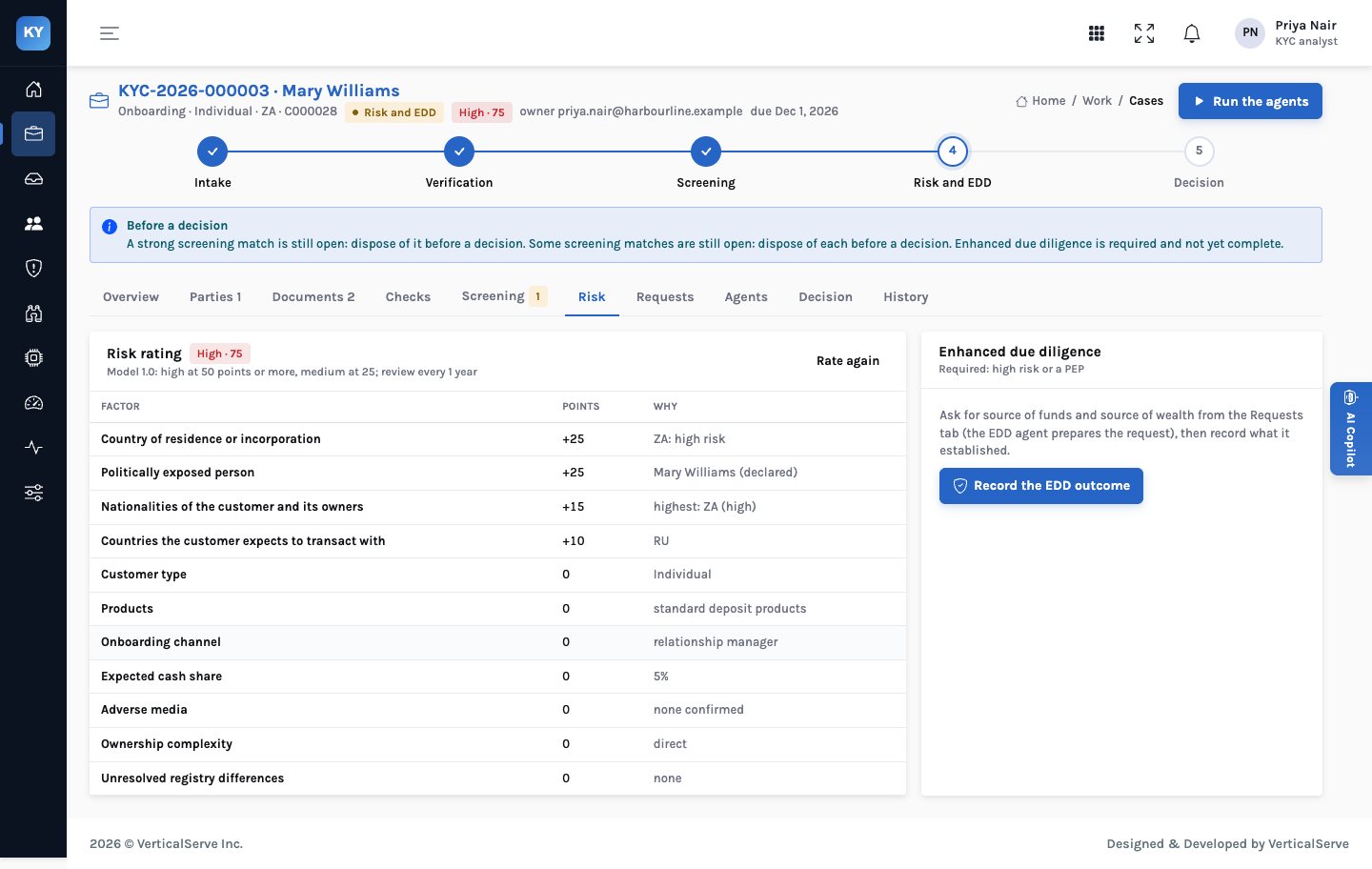
Each risk factor with its points and why; each check with the line of the document it read; each screening disposition with its reason and who made it.
InsightKYC was built around the second column. A risk assessment lists each factor, the points it added and the reason; the model version and the thresholds are on the screen. A check quotes the line of the document it read. A screening match shows the name, date-of-birth and nationality comparison separately, and its disposition records who decided and why.
Higher-risk relationships
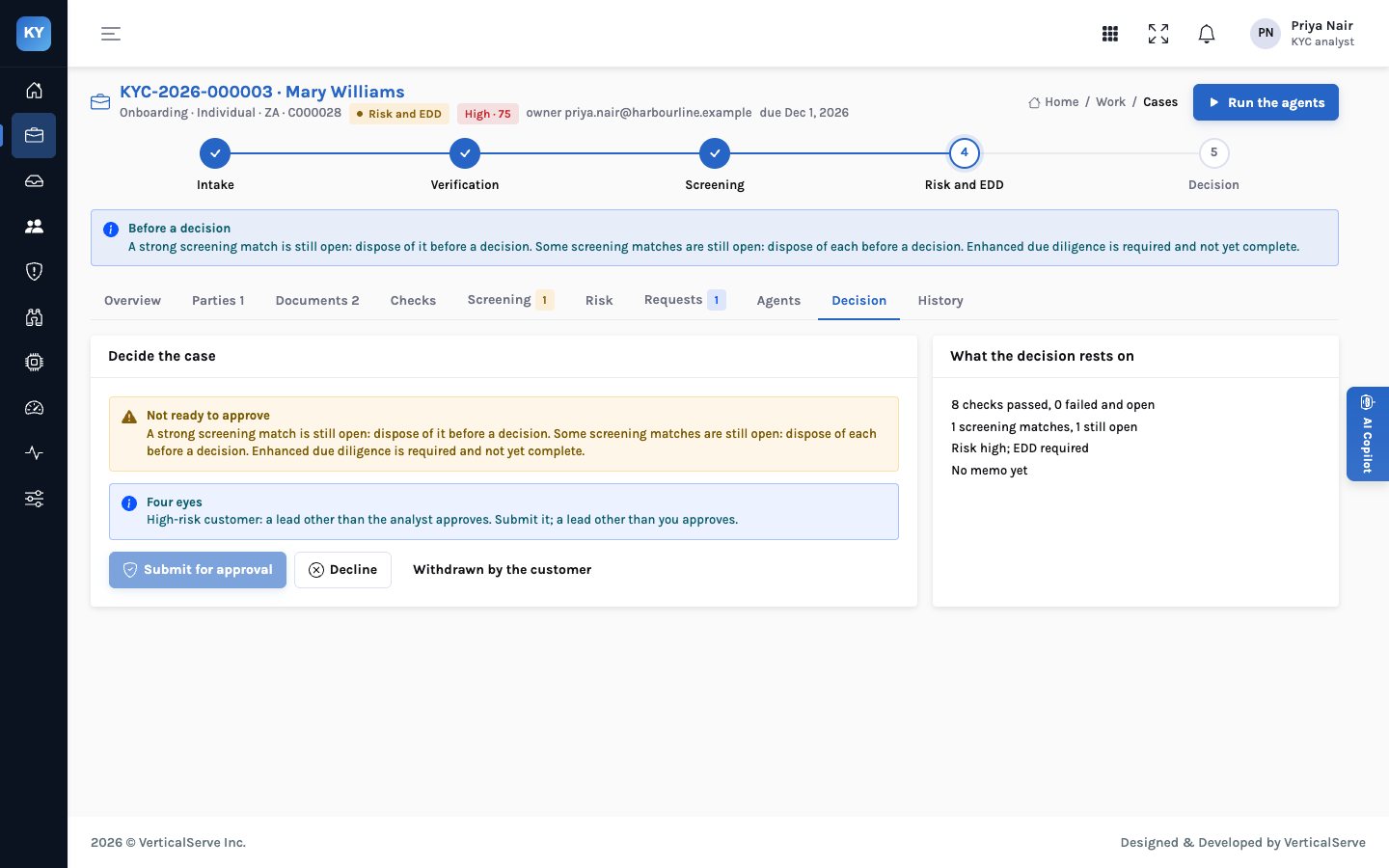
Enhanced due diligence is where files most often fall short, because “enhanced” is left undefined. A useful test is whether the file answers four questions:
- Why is this customer higher risk? The factors, named.
- What extra did the bank find out? Source of funds, source of wealth, the reason for an unusual structure, the expected activity in more detail.
- What evidence supports it? Documents, not just the customer’s word, in proportion to the risk.
- Who approved the relationship? For foreign PEPs FATF calls for senior management approval; many banks require a second approver for every high-risk customer.
Ongoing due diligence
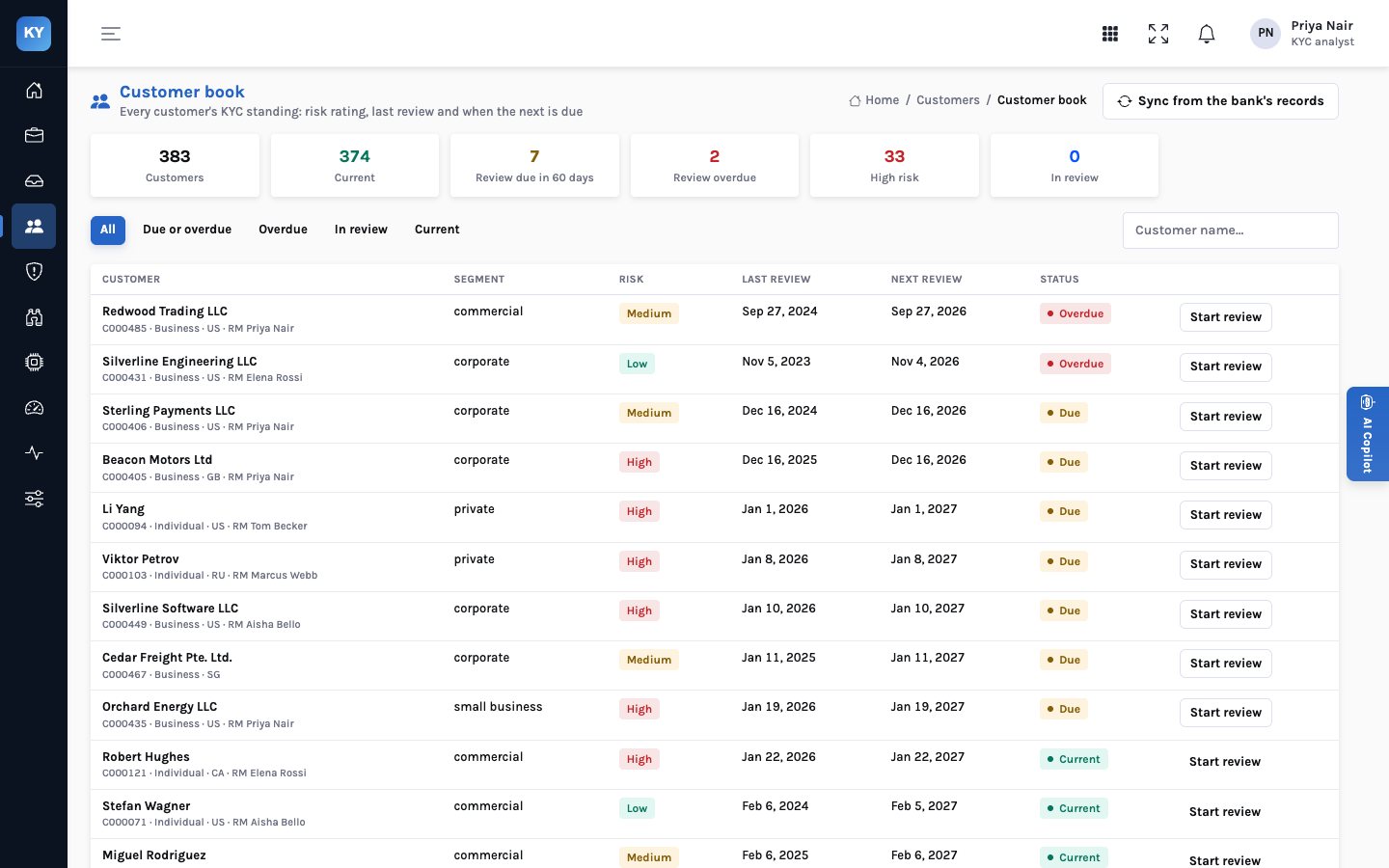
Onboarding gets the attention; ongoing due diligence gets the findings. It has two parts: periodic review on a cycle set by risk, and event-driven review when something changes, such as unusual activity, a screening hit or a change of ownership. The common failure is a review schedule that is not tied to the current rating, so high-risk customers wait as long as everyone else.
What it means for each audience
For the CCO & MLRO
Make the methodology executable: if the rating can be recomputed from the written factors, consistency stops being a matter of training.
Measure overrides, overdue reviews and disposition quality as closely as volumes.
For the KYC operations lead
Every file should answer the examiner’s question without the analyst in the room: what was checked, against what, and why the outcome followed.
Treat a missing reason as a defect, even when the outcome was right.
For the board
Supervisory findings on KYC are expensive in remediation, in restrictions on growth and in reputation. The cheapest defence is files that show their own reasoning.
Ask for the overdue-review number and the override rate; they say more than the headcount.
Supervisors do not examine your policy. They examine whether your files prove you followed it.
Build files that carry their reasons, and the examination becomes a reading exercise.