Every bank asks a business customer the same question: who owns you? The honest answer is often a diagram, not a name: a holding company in one jurisdiction, a trust in another, and two or three people somewhere behind them. The rules on beneficial ownership exist to make sure the bank reaches those people. They agree on the idea and differ on the details, and the details are where onboarding files fail.
In short
- The goal everywhere is the natural person. FATF, the US, the EU and the UK all ask who ultimately owns or controls a legal entity, not which company sits on top of the register.
- Twenty-five percent is common but not universal. The US CDD Rule uses “25% or more”; the UK regulations use “more than 25%”; FATF gives 25% as an example rather than a rule; the EU allows lower thresholds for higher-risk entities.
- Ownership alone is not enough. Every regime also asks who controls the entity, and falls back to a senior managing official when nobody can be identified.
- Indirect ownership has to be calculated, not read. A person holding 80% of a company that holds 70% of the customer owns 56% of it. Sanctions are different again: OFAC’s 50 Percent Rule looks at aggregate ownership by blocked persons.
The international standard: FATF
The Financial Action Task Force sets the standard national rules follow. Two of its Recommendations matter here.
- Recommendation 10 (customer due diligence) requires financial institutions to identify the beneficial owner of a customer and take reasonable measures to verify that person’s identity, and, for legal persons and arrangements, to understand the ownership and control structure.
- Recommendation 24 addresses the other side: it requires countries to make sure adequate, accurate and up-to-date beneficial ownership information on companies is available to authorities. FATF revised it in 2022 to call for a multi-pronged approach, including a beneficial ownership registry or an alternative mechanism. Recommendation 25 does the same for trusts and other legal arrangements, and was revised in 2023.
FATF’s interpretive note to Recommendation 10 describes a cascade for legal persons, which most national rules echo:
The natural persons who ultimately hold a controlling ownership interest. FATF gives a threshold as an example of how this may be set, such as more than 25%, rather than fixing one.
Where there is doubt, or nobody holds such an interest, the natural persons who exercise control of the company through other means: voting agreements, the power to appoint directors, influence.
Where no natural person is identified under either step, the person who holds the position of senior managing official.
The United States: the CDD Rule
For US banks the operative requirement is FinCEN’s Customer Due Diligence Rule, at
31 CFR 1010.230. When a legal entity customer opens a new account, the bank must
identify and verify its beneficial owners, defined in two prongs:
- Ownership prong: each individual who, directly or indirectly, owns 25% or more of the equity interests of the legal entity. That can be up to four people, or none.
- Control prong: one individual with significant responsibility to control, manage or direct the entity, such as a chief executive, chief financial officer, managing member or president. There is always one.
The rule lists categories of legal entity customers that are excluded, such as certain regulated financial institutions and companies listed on US exchanges, and it sits alongside the requirement in the bank’s program rules to understand the nature and purpose of the relationship and to keep customer information current through ongoing monitoring.
The Corporate Transparency Act: check the current position
The Corporate Transparency Act created a separate obligation on companies to report their beneficial owners to FinCEN. Its status has changed several times: after litigation, FinCEN issued an interim final rule in March 2025 that removed the reporting requirement for US companies and US persons, leaving it in place for certain foreign companies. Further changes are possible, so check FinCEN’s current guidance. Whatever happens to company reporting, a bank’s own obligations under the CDD Rule continue, and a company’s report to FinCEN is not a substitute for the bank identifying and verifying beneficial owners itself.
The European Union: the AMLR and AMLA
The EU has moved from directives, which each member state transposed differently, to a single regulation. The Anti-Money Laundering Regulation, Regulation (EU) 2024/1624, applies directly in every member state from July 2027. A new authority, AMLA, established by Regulation (EU) 2024/1620, will supervise some of the largest cross-border firms directly and coordinate national supervisors.
Under the AMLR, the beneficial owners of a legal entity are the natural persons who control it through an ownership interest or through other means. An ownership interest means holding 25% or more of the shares, voting rights or other ownership interest, directly or indirectly. The regulation sets out how indirect ownership through chains of entities is to be counted, and allows the Commission to set a lower threshold for categories of entity it identifies as higher risk. Control through other means is spelled out in more detail than in the earlier directives: rights to appoint or remove board members, veto rights, decision rights over profit distribution, and control through formal or informal agreements.
Where the regimes differ
| Question | FATF | US CDD Rule | EU AMLR | UK MLRs 2017 |
|---|---|---|---|---|
| Ownership threshold | Example given (e.g. more than 25%), not fixed | 25% or more of equity interests | 25% or more; lower thresholds possible for higher-risk categories | More than 25% of shares or voting rights |
| Control | Control through other means | Exactly one control-prong individual, always | Detailed list of control through other means | Control through other means |
| Nobody identified | Senior managing official | The control prong always names someone | Senior managing officials, with the reasons recorded | Senior managing official, with steps taken recorded |
| Who must hold the data | Countries: registry or alternative mechanism | Banks collect at account opening | Obliged entities, plus central registers | Firms, plus the Companies House PSC register |
The table is a simplification: each regime has exemptions, definitions of equity interest and rules for trusts that matter in practice. Two differences cause most of the trouble in a multinational bank:
- “25% or more” versus “more than 25%”. A person holding exactly 25% is a beneficial owner under the US and EU rules and not under the UK definition. A global policy usually takes the stricter reading.
- A register is evidence, not proof. Central registers make the work easier, but banks are generally still expected to take their own risk-based measures, and many regimes expect discrepancies between what the customer tells the bank and what the register shows to be followed up.
Indirect ownership: do the multiplication
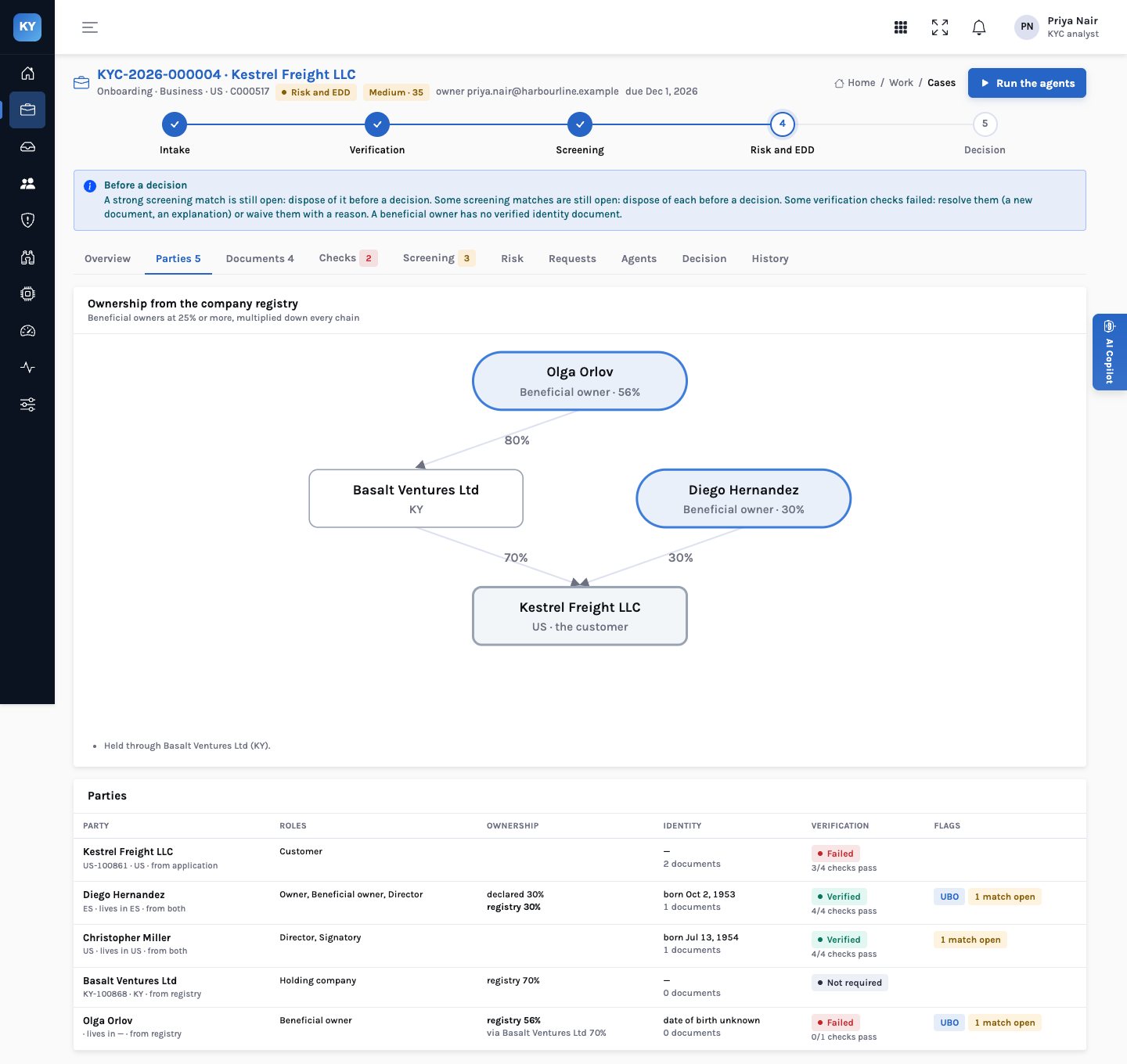
The most common error in a beneficial ownership file is reading a percentage from the wrong level of the structure. Consider the case below, from InsightKYC’s fictional demo bank. A US freight company applies for an account. Its application names one owner, Diego Hernandez, with 30%. The registry shows the other 70% held by Basalt Ventures Ltd, a company in the Cayman Islands. Basalt’s own register shows Olga Orlov holding 80%.
Olga Orlov holds 80% × 70% = 56% of the customer. She is a beneficial owner under every regime in the table, and the application did not name her.
Multiplying down each chain and adding the chains that reach the same person gives the effective holding. Done by hand, with registry extracts for each layer, it is slow and easy to get wrong. Done automatically, it becomes the first thing an analyst sees.
Sanctions ownership is a different calculation
OFAC’s 50 Percent Rule answers a different question: is this entity itself blocked? Under OFAC’s guidance, an entity owned 50% or more in the aggregate, directly or indirectly, by one or more blocked persons is treated as blocked, even if it is not named on a list. Two features make it different from beneficial ownership:
- It aggregates across blocked persons. Two sanctioned people holding 25% each together reach 50%.
- Blocked status passes down the chain. If a blocked person owns 50% of company A, A is blocked; if A owns 50% of company B, B is blocked too, so the relevant holdings are not multiplied the way beneficial ownership percentages are.
The practical lesson is that a bank needs the whole ownership graph, not a list of the people above 25%, so it can answer both questions from the same data. Other sanctions authorities have their own ownership and control tests, which also need checking.
What a good file contains
Each owner and controller the customer named, with their percentages.
Each layer of the structure, with its source and date, including entities in other jurisdictions.
Every chain multiplied out, every person at or above the threshold identified, and the threshold applied stated.
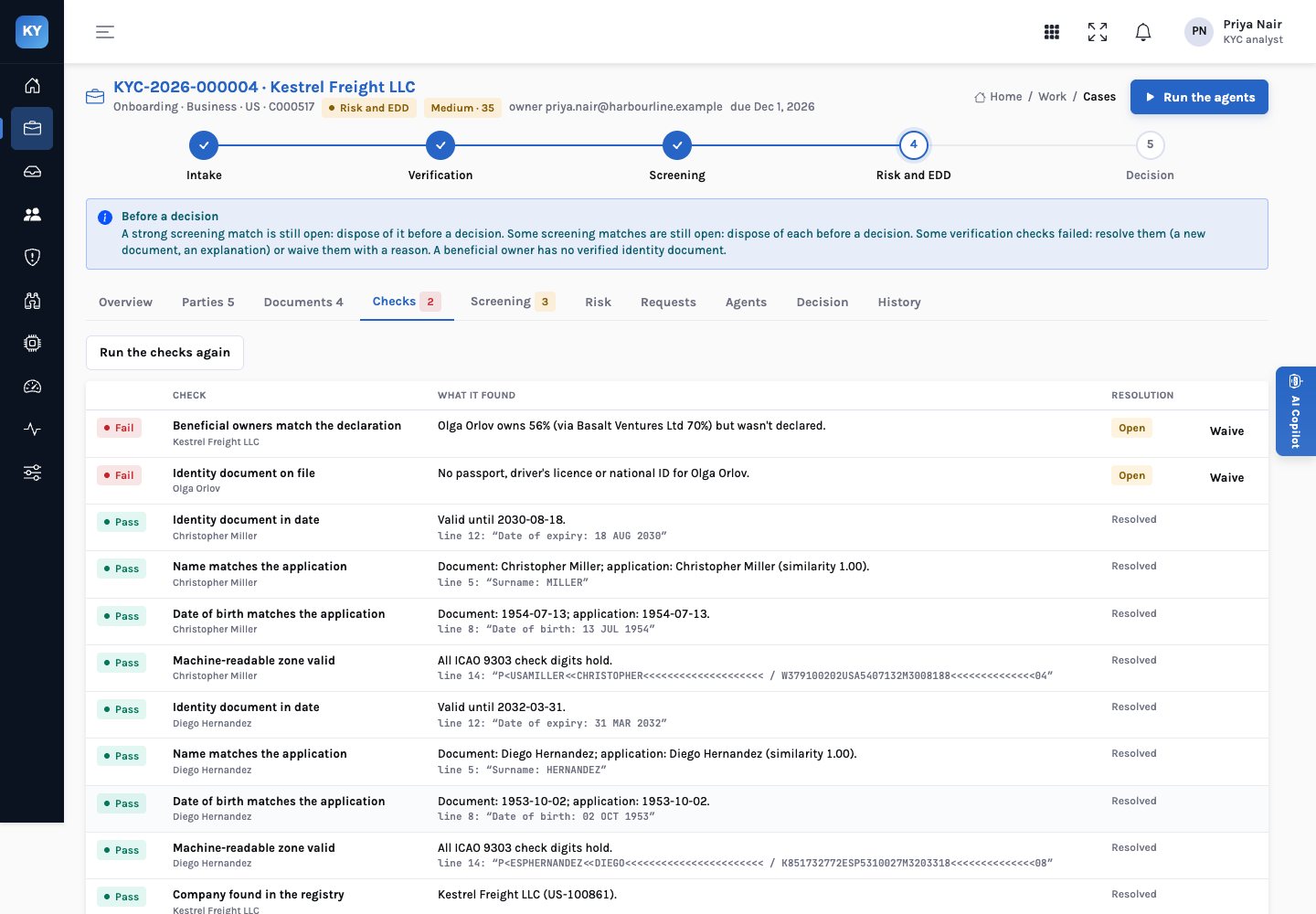
Undeclared owners, percentages that differ, officers not named, and how each was resolved.
Identity verified for each beneficial owner and controller, on a risk basis.
Who controls the entity, and, where no owner is found, the senior managing official with the reasons.
InsightKYC builds the first four from the registry and the application automatically, records each difference as a check (an undisclosed owner, an undisclosed officer, a percentage that differs), and adds every beneficial owner and controller as a party to be verified and screened. The ownership threshold is a setting, so a bank can apply the stricter reading where it needs to.
What it means for each audience
For the CCO & MLRO
Write down which threshold the bank applies in each jurisdiction and why. A global policy that takes the strictest reading is simpler to examine than a patchwork.
Treat a discrepancy with a register as a finding to resolve, not a footnote.
For the KYC operations lead
The calculation is where files go wrong. Make the tree and the effective percentages the first thing an analyst sees, and record each layer’s source.
Ask the customer to explain any owner they did not declare; that explanation belongs in the file.
For the board
Beneficial ownership is how criminals and sanctioned persons hide behind companies. A bank that cannot show who is behind its corporate customers is exposed in every jurisdiction it operates in.
The rules are converging; the evidence a good file needs is already the same everywhere.
The register tells you which company owns the customer. The rules ask which person does.
Walk every chain, multiply every percentage, and keep the evidence for each layer.